
Get Faster, Safer Warehousing Solutions
Speed Up Your Production While Improving Safety with Vertical Reciprocating Conveyors

What Is a Vertical Reciprocating Conveyor?

Cost-effective and spatially efficient

Customizable

Enhances safety

Improves productivity
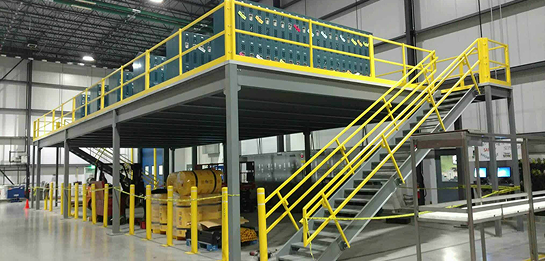
Many VRCs are installed at the edge of mezzanines or between floors, allowing materials to move safely from ground level to upper levels without anyone having to carry items upstairs or operate a forklift near an open edge.
As a result, they offer much more value than a parts lift or an elevator used to move people.
For example, a VRC is much easier to install and costs much less than an elevator, since elevators that carry people are governed by extremely strict regulations and VRCs are not.
And because VRCs are designed exclusively for material handling, they’re also more flexible and customizable to meet your needs, making them better suited for your warehouse applications.
Multiple VRC Configurations for Maximum Flexibility
Depending on your building layout, process, and workflow, Champion Sales can configure your VRC in a variety of ways:
- Front-loading systems, where materials are loaded and unloaded from the same side
- Front-and-back systems, allowing materials to enter from one side and exit from the opposite side
- Z-style configurations, commonly used at mezzanine edges, where materials are loaded at ground level and unloaded in the opposite direction on the upper floor
These configurations are especially useful in tight spaces or when your upper-level workflow differs from what happens below. The result is a smoother, more logical flow of materials throughout your facility.
Safer Than Forklifts and Manual Handling
One of the biggest advantages of a VRC is safety.
Without a VRC, many warehouses rely on forklifts to move pallets to mezzanine edges or have employees manually carry parts up stairways.
However, both options come with risk; forklifts operating near open edges create a number of dangerous conditions, while manual handling increases the likelihood of worker injury and fatigue.
A VRC eliminates these hazards by providing a controlled, enclosed way to move materials vertically.
That means your workers stay safely on solid ground, parts stay contained, and the entire process becomes safer and more predictable.
Why More Warehouses are Choosing VRCs
Many of our clients come to us with the same challenge:
“We’ve expanded our product lines, our inventory has grown, and we need more capacity…
…but we don’t want to move locations or add on to our existing building.”
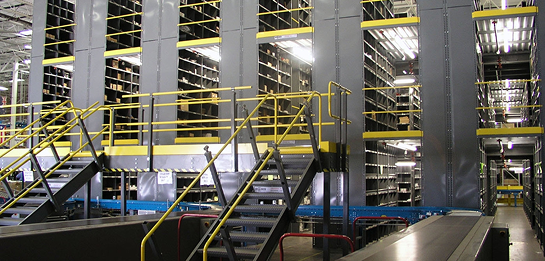
This is where vertical movement becomes a key part of the solution by helping your company expand to upper levels.
This allows you to:
- Maximize unused vertical space
- Feed mezzanines and upper levels efficiently
- Eliminate risky manual lifting and carrying
- Reduce forklift traffic near elevated edges
- Improve throughput and workflow
With a VRC in place, materials can be loaded at ground level and delivered exactly where they’re needed upstairs. And if materials need to go back down, a VRC makes work just as easy.
How Would Your Warehouse Benefit from a VRC?
Any operation that stores, picks, assembles, or ships materials across multiple levels will enjoy benefits from a VRC, both immediately and long-term.
Whether you’re handling heavy components, small parts, or mixed inventory, a VRC allows you to integrate vertical movement directly into your material handling strategy.
And because these systems are built around your specific products and volumes, they scale with your operation as it grows while reducing common risks and hazards to your workforce and property.
With their countless benefits, Champion Sales has provided VRCs for businesses across a wide range of industries. Let us design and install one for you.
Designed Around Your Materials and Workflow
Fortunately for your business, not all VRCs are the same.
Rather, their ability to be customized to improve your operations is one of the greatest strengths by a VRC.
But before Champion Sales gets started with your VRC’s design, we first ask the critical questions, such as:
- Are you moving full pallets or individual parts?
- Will materials be loaded on carts, skids, or conveyors?
- Do you need waist-level or chest-level loading to reduce bending?
- Are you feeding a mezzanine, a picking area, or a shipping zone?
Depending on your needs, your VRC might:
- Handle full pallets
- Move carts or containers
- Deliver individual parts at an ergonomic height
With decades of experience helping customers like you, we know that there’s no one-size-fits-all solution.
That’s why we take the time to design a system that fits seamlessly into how your team already works, providing a VRC system that improves speed, safety, and efficiency.